Anthropic shipped Claude Opus 4.8 last Thursday, and with it a Claude Code feature called Dynamic Workflows that lets a single session plan a job, split it across tens or hundreds of subagents, verify the results and hand back one answer. The model is the headline. The workflow feature is the one that changes how a small crew works, and the one that can empty a budget if you let it.
Here is what shipped, where we are using it on client builds, and the rules we put around it before we did.
Opus 4.8 in One Paragraph
Same price as Opus 4.7 at $5 per million input tokens and $25 per million output. Fast mode dropped to $10 and $50, a third of what it cost. The claim that matters for code is specific: Anthropic says the new model is around four times less likely than its predecessor to let a flaw in code it has written pass unremarked. It is available everywhere on day one, including Amazon Bedrock, which matters for the clients whose builds live entirely inside their AWS account.
We have run it for a few days on two live builds. The self-review claim holds up in the sense that matters: fewer "wait, that will break when the list is empty" comments from us, because the agent left them for itself first. That does not replace review. It makes review shorter.
What Dynamic Workflows Actually Does
Until now, parallelism in Claude Code meant you ran several sessions and coordinated them yourself, or you asked one session to spawn a handful of subagents for a task. Dynamic Workflows moves the coordination into the agent.
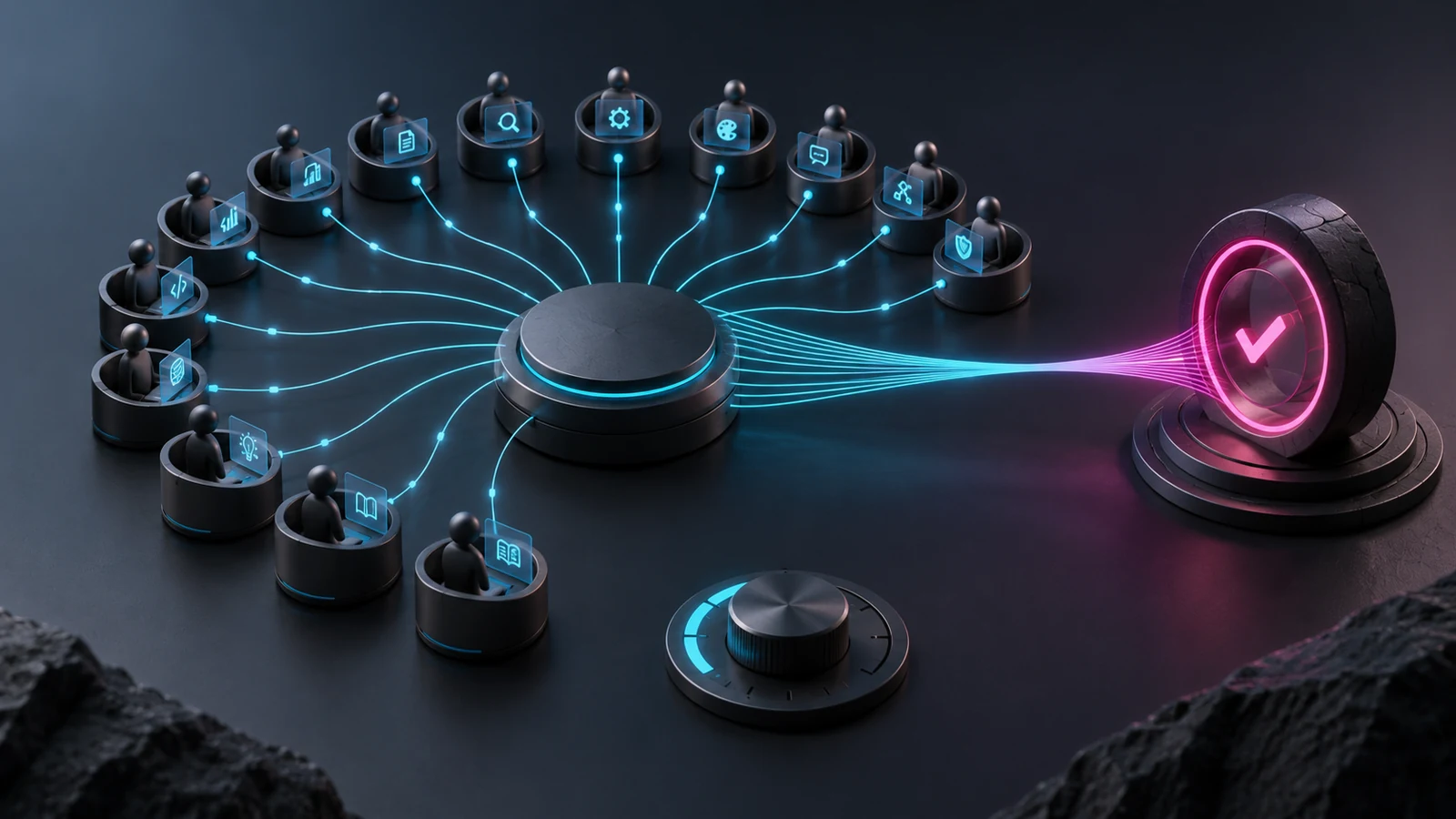
You describe a large job. Claude writes an orchestration script, breaks the job into subtasks, runs them across parallel subagents, and verifies what comes back before folding it into the result. Anthropic describes agents attacking a problem from independent angles while other agents try to refute the findings, iterating until the answers converge. Progress is saved as it goes, so an interrupted job resumes rather than restarts, and the coordination happens outside your conversation so the session stays readable.
The example Anthropic leads with is the Bun runtime's port from Zig to Rust: 750,000 lines of Rust, 99.8 percent of the test suite passing, eleven days from start to merge.
You trigger it by asking for a dynamic workflow, or by turning on an ultracode setting that pushes effort to its highest level and lets Claude decide when a workflow is warranted. It is on by default for Max, Team and Enterprise plans and for API users, and opt-in for Pro. The first time one fires, Claude Code shows what it is about to run and waits for you to confirm.
Then there is the sentence in the announcement that every founder should read twice: dynamic workflows consume substantially more tokens than a typical Claude Code session.
Where We Let It Fan Out
Dynamic Workflows is built for work that is wide rather than deep. A few kinds of client work fit that exactly, and all of them live in Cruise & Maintenance rather than in a first build.
Migrations. A framework upgrade, an API deprecation across a hundred call sites, a language version bump. The work is repetitive, verifiable by the test suite, and miserable to do by hand. This is the Bun case at client scale, and it is where we expect the biggest wins.
Test coverage sweeps. A product that shipped fast usually shipped with thin tests. Handing an agent workflow the job of reading every module and writing the missing cases is a fortnight of engineering time compressed into an afternoon, and the output is easy to judge: the tests either pass and catch things or they do not.
Security and dead-code audits. Anthropic names codebase-wide bug hunts and security audits as intended uses. For a client entering a compliance conversation, an audit that reads every file with a second set of agents trying to disprove the findings is a good first pass before a human does the expensive one.
Where We Do Not
A greenfield MVP feature. The constraint on a first build is never how many agents are writing code. It is whether the spec is right. Fanning a fuzzy spec out across fifty subagents produces fifty confident versions of the wrong thing, faster. In Takeoff & Climb we stay at a handful of agents, one per roadmap item, with a human reading every branch.
Anything the client has not asked to pay for. Which brings us to the bill.
Keeping It Inside the Proposal
The industry's other news this week is cost. GitHub moved every Copilot plan to usage-based billing today, and the developer forums are full of people whose modest monthly bills have suddenly multiplied. Agent spend is now a metered utility, and Dynamic Workflows is the biggest tap on it.
Our rules on client work:
- Scoped first. Anthropic's own advice is to start on a scoped task to get a feel for usage. We run a workflow on one module before we point it at a repository.
- Quoted as a line item. A migration or an audit that will use a dynamic workflow is priced in Clearance with an estimated token spend and a ceiling, the same way we quote cloud infrastructure. If the ceiling is hit, the workflow stops and we talk.
- Measured. We check the cost after every workflow run and keep the number next to the outcome, so the next quote is better than the last.
- Never unattended on a subscription meant for people. The overnight, wide-fan-out work runs on metered API access with a budget cap, not on a plan whose limits were set for a person typing.
None of this is exotic. It is the same discipline we apply to a Lambda bill. The difference is that a workflow can spend a month's budget in an hour if nobody set the cap.
What This Means for Your Product
If you have a product in maintenance, a whole category of work that used to be "we will get to it" just became affordable: the upgrade you have been putting off, the tests you never wrote, the audit before the enterprise deal. If you are starting a build, nothing changes about the first fortnight, and be wary of anyone who tells you a hundred agents will make the spec matter less.
Got a Migration You Have Been Putting Off?
At Dev Force One, Cruise & Maintenance is where Opus 4.8 and Dynamic Workflows earn their keep: the wide, verifiable jobs that keep a shipped product airworthy, priced and capped before they run.
What we offer:
- Migrations and upgrades run as scoped, verified agent workflows with a spend ceiling
- Test coverage and audits that read every file so the humans can spend their time on the findings
- Honest first builds: a handful of agents, one per roadmap item, and a human on every branch
Want to know what that overdue upgrade would cost with a workflow behind it? Book a Pre-flight call and we will scope it.